
How Head to Head works
We take the top-ranked product from each category and test them against each other. Rather than listing specs, we give you a real verdict on which one is the better choice for your specific situation — and exactly when to buy each one.
Electric Pressure Washer vs Petrol Pressure Washer: Which Is Right for Home Use?
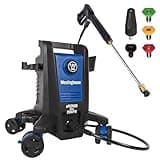
Westinghouse ePX3500 Electric Pressure Washer, 2500 Max PSI 1.76 Max GPM with Anti-Tipping Technology, Onboard Soap Tank, Pro-Style Steel Wand, 5-Nozzle Set, for Cars/Fences/Driveways/Home/Patios
Quiet, low-maintenance, and sufficient for most driveways


Professional 4200PSI 4GPM 212CC Gas Pressure Washer, 7.0HP Heavy-Duty 3600RPM Commercial Gas Power Washer with 10" Wheels 3000ML Foam Bottle 5 Nozzles 33FT Hose Reel (EPA/CARB/ETL Compliant), Black
Maximum power, no cable — built for commercial and agricultural use
Our verdict — Electric wins
For home use — driveways, patios, cars, garden furniture, fences — an electric pressure washer is the right choice for the overwhelming majority of people. Modern electric models deliver 130–180 bar of pressure, which is sufficient to clean every domestic surface effectively, including green algae on block paving and oil stains on concrete. They start instantly, require no fuel, produce no fumes, and need virtually no maintenance. Petrol pressure washers are more powerful and fully portable, but that power is designed for agricultural buildings, commercial forecourts, and industrial equipment — applications where electric supply is unavailable and surface area is vast. Buying one for a residential driveway is like using a road roller to park a car.
Buy Electric if…
You are cleaning domestic surfaces — driveway, patio, car, bike, decking, garden furniture — from a residential property.
Buy Petrol if…
You need to clean large agricultural or commercial surfaces far from a power supply, or you run a cleaning or valeting business.
Pressure washers are one of those purchases where the temptation to overbuy is genuinely strong. More bar of pressure means a cleaner driveway — or so it seems. The result is that many people end up with a heavy, noisy, fuel-dependent petrol machine in their garage when a lighter, quieter, plug-in electric model would have done the job better and with less hassle.
The distinction between electric and petrol pressure washers is not just about power. It is about a completely different use case. Petrol models exist because commercial and agricultural users need machines that work far from a power socket, for hours at a time, on extremely large or heavily soiled surfaces. They are built for farms, forecourts, and scaffolding contractors — not for cleaning a patio on a Saturday morning.
Electric models have improved dramatically. Current mid-range electric pressure washers deliver pressures that were only achievable with petrol machines a decade ago. They are lighter to move, cheaper to run, and take zero preparation time.
This comparison is honest about who petrol machines are actually built for — and helps you avoid an expensive, oversized mistake.
Compare prices on Amazon
Quiet, low-maintenance, and sufficient for most driveways
Maximum power, no cable — built for commercial and agricultural use
Pressure and cleaning power
A mid-range home electric pressure washer delivers 130–160 bar of pressure, with flow rates of 6–8 litres per minute. Premium electric models reach 180 bar. For context: cleaning block paving of moss and algae requires around 120–140 bar. Stripping paint from a brick wall requires around 150 bar. Washing a car safely requires 80–100 bar with a wide-angle nozzle. Every domestic cleaning task falls comfortably within the range of a quality electric machine.
Petrol pressure washers start at around 200 bar and reach 250–300 bar in commercial models, with flow rates of 10–15+ litres per minute. That additional pressure is not a luxury — it is designed for surfaces that a domestic user will simply never encounter: concrete agricultural floors covered in slurry, heavy machinery with baked-on grease, multi-storey building facades. On a residential patio or car, that pressure requires careful nozzle management to avoid etching the surface or stripping sealant. More pressure is not always better; it is sometimes damaging.
Practicality and ease of use
Electric pressure washers plug in and start immediately. There is no fuel to mix or store, no pull-cord, no warm-up period, and no oil level to check. You take it out of storage, connect the hose, plug it in, and start washing. After use, you flush the system, roll up the hose, and put it away. Total setup and pack-down: under five minutes.
Petrol pressure washers require fuel (either petrol or mixed petrol/oil depending on the engine type), oil level checks, and pull-cord starting that can be difficult in cold weather. They produce carbon monoxide and must be used in open air or well-ventilated spaces — not in a garage, not in a covered car port. They are heavier and noisier. After use, they require flushing, and if stored for more than a few weeks, the fuel should be run out or stabilised to prevent carburettor gumming. For a machine used infrequently — as most home pressure washers are — the maintenance demands of a petrol engine become a real friction point.
Cost
A quality home electric pressure washer costs between £80 and £200. Running costs are minimal: standard household electricity, occasional replacement of O-ring seals, and a new pressure hose every few years if it develops a crack. Most models require no servicing.
Entry-level petrol pressure washers start around £300 and quality machines sit at £400–£700. Running costs include fuel, engine oil, annual servicing (spark plug, air filter, oil change), and the increased likelihood of needing professional repair if the engine develops a fault. For a machine used six to ten times a year on a residential property, the total cost of ownership of a petrol model significantly exceeds electric over a five-year period.
The price premium for petrol is justified when the machine earns money — a window cleaner, groundskeeper, or mobile valeting business gets real return on investment. For a homeowner using it on weekends, the economics do not work.
Who should use which
An electric pressure washer is right for: homeowners cleaning patios, driveways, paths, garden furniture, cars, bikes, or fences. It handles every standard domestic surface, takes up less storage space, and costs less to buy and run. The limit of electric becomes relevant only when you need to work very far from a power socket for extended periods, or you are cleaning surfaces of genuine commercial scale.
A petrol pressure washer is right for: farmers and smallholders cleaning outbuildings, slurry yards, and large concrete areas; tradespeople who need a professional machine with no dependency on site power; and anyone who regularly washes large commercial vehicles or heavy plant equipment. If none of those descriptions fits your situation, the petrol machine is the wrong tool.
Ready to buy? Check current prices below
Quiet, low-maintenance, and sufficient for most driveways
Maximum power, no cable — built for commercial and agricultural use
Frequently Asked Questions
My patio is covered in black algae — will an electric model actually shift it?▾
Yes. Black algae and lichen on block paving or stone responds to 130–160 bar of pressure with a surface cleaner attachment, which is within the range of mid-range electric machines. Using a surface cleaner (a rotating disc attachment) is more effective and faster than a lance for flat surfaces, and avoids the striping pattern left by a single-nozzle approach.
Can I use a pressure washer to clean my car safely?▾
Yes, with the right nozzle. Use a wide-angle (25-degree or 40-degree) nozzle and keep the lance at least 30cm from the bodywork. Never use a zero-degree (pencil jet) nozzle on paintwork — it will strip paint and damage clear coat. Keep pressure below 100 bar for painted surfaces. A foam cannon attached to the pressure washer is ideal for pre-soaking, which reduces the pressure required.
How important is bar pressure versus flow rate (litres per minute)?▾
Both matter, and the relationship between them determines real-world cleaning power. Bar pressure determines the force of the water; flow rate determines the volume. A machine with very high pressure but a low flow rate cleans a small spot intensely. A machine with moderate pressure and a higher flow rate covers more area quickly. For domestic use, 130 bar at 7–8 litres per minute is a better practical specification than 160 bar at 5 litres per minute.
Does storage matter for electric models?▾
Less than petrol. Electric pressure washers should be stored in a frost-free environment — water in the pump and hose can cause damage if it freezes. Run the system briefly to expel standing water before long winter storage. Beyond that, they require no particular preparation and can be stored in a garage or shed without issue.
My garden has no outdoor power socket — does that rule out electric?▾
Not automatically. Most electric pressure washers operate on a standard 13-amp socket and can be run on a heavy-duty outdoor extension lead (rated for the wattage of the machine). Check the machine's power draw and use a lead of appropriate rating. For long distances or frequent use from an indoor socket, it is worth having an outdoor socket installed — a straightforward job for an electrician.