How Head to Head works
We compare two products or product types head to head, giving you a real verdict on which is the better choice for your situation — and exactly when to choose each one.
Silicone vs Wooden Utensils: Which Should Be Your Daily Drivers?
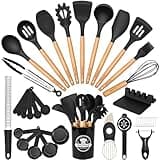
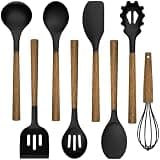
Astercook 39 PCS Kitchen Utensils Set, Silicone Cooking Utensil Sets with Wooden Handle, 446°F Heat Resistant Food Grade Spatula Set, BPA Free Kitchen Gadgets Tools Set & Spoons for Nonstick Cookware
The nonstick-safe, dishwasher-friendly all-rounder

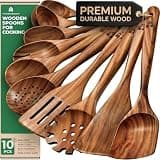
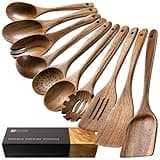
Wooden Spoons for Cooking – 10 Pcs Teak Wood Utensil Set, Durable, Nonstick Safe & Heat Resistant with Ergonomic Handles
The traditional choice — durable, natural, and open-flame safe
Our verdict — Silicone wins
For most modern kitchens built around nonstick and ceramic-coated cookware, silicone utensils are the better daily choice — they won't scratch coatings, they're dishwasher-safe, and they hold up to years of use without cracking. Wooden utensils are still the right call if you cook a lot over open flame or high direct heat, since silicone can scorch or soften near a flame in a way wood simply doesn't. Most well-equipped kitchens end up with a few of each rather than picking one exclusively.
Buy Silicone if…
You cook mainly on nonstick or ceramic cookware and want low-maintenance, dishwasher-safe tools that won't scratch your pans.
Buy Wooden if…
You regularly sear over high heat, cook with cast iron or a wok on open flame, or simply prefer the traditional feel for stirring sauces and risottos.
A scratched nonstick pan is one of the most common, most avoidable kitchen disappointments, and it usually traces back to using the wrong utensil rather than a bad pan. Silicone and wooden utensils solve overlapping but genuinely different problems, and picking between them isn't just a style preference — it affects how long your cookware lasts and how much time you spend scrubbing.
A silicone utensil is a flexible, heat-resistant tool molded around a metal or plastic core, built specifically to be gentle on modern nonstick and ceramic coatings. A wooden utensil is a solid, carved tool — usually beech, olive, or bamboo — that predates nonstick cookware entirely and still outperforms silicone in a few specific, common situations.
This article covers what each one actually does well, where the real differences show up in daily cooking, and which set makes more sense for your kitchen in 2026 — or whether the honest answer is a mix of both.
What is a Silicone Utensil Set?
Silicone utensils are molded from food-grade silicone, typically over an internal steel or nylon core for rigidity. The material is naturally heat-resistant up to roughly 450–500°F, flexible enough to scrape a bowl clean, and soft enough that it won't scratch nonstick, ceramic, or ceramic-coated cast iron the way metal or even some hard plastics can.
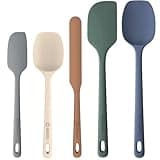
The specs worth checking before buying are the internal core material (steel cores last longer and resist bending under pressure better than nylon), the silicone grade (food-grade, BPA-free silicone is standard, but cheaper imports sometimes cut corners), and the seam where the silicone head meets the handle — a poorly sealed seam is where these utensils typically fail first, trapping moisture and eventually cracking.
Silicone is the right choice for anyone cooking primarily on nonstick or ceramic-coated pans, which describes most home kitchens today. It's also the better pick if dishwasher convenience matters to you, since silicone tolerates repeated hot-cycle washing far better than wood does over time.
What is an Wooden Utensil Set?
Wooden utensils are carved or lathed from a single piece of hardwood — most commonly beech, olive wood, teak, or bamboo (technically a grass, but functionally similar in kitchen use). They have no moving parts, no seams, and nothing that can melt, discolor, or soften under heat, which is the core of their long-standing appeal.
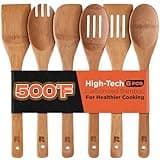
Key things to check are the wood type (denser hardwoods like olive and teak resist splitting and absorbing odors better than softer woods), whether the piece is finished with food-safe mineral oil rather than varnish, and the thickness at stress points like the neck of a spoon, which is where cheaper mass-produced wooden utensils tend to crack first.
Wood is the right choice for anyone who cooks regularly over high or open-flame heat — gas stovetop searing, cast iron work, or anything where a utensil rests directly against a hot pan edge for extended periods. It's also the traditional pick for stirring risottos, sauces, and stocks, where many cooks simply prefer the feel and the fact that it won't ever transfer a rubbery texture or smell to food.
Key Differences
Pros & Cons
Silicone
- ✓Won't scratch nonstick, ceramic, or ceramic-coated cast iron cookware
- ✓Dishwasher-safe, which matters far more day-to-day than most buyers expect
- ✓Non-porous surface resists staining and doesn't hold onto strong food odors
- ✗Can scorch, soften, or discolor if left resting against an open flame or a very hot pan edge
- ✗The seam where the head meets the handle is a common long-term failure point on cheaper sets
Wooden
- ✓Handles open-flame and high direct heat without melting, softening, or discoloring
- ✓No plastic or silicone taste transfer, which some cooks notice especially in delicate sauces
- ✓Ages well with visible character rather than looking worn out
- ✗Requires hand washing and periodic oiling — dishwasher cycles dry out and crack the wood over time
- ✗Can absorb strong odors like garlic, onion, or turmeric if not cleaned and dried promptly
Versatility across cookware types
Silicone utensils work safely across the widest range of cookware — nonstick, ceramic, ceramic-coated cast iron, stainless steel, and enameled cast iron all tolerate silicone without risk of scratching. A single silicone set can move between every pan in a typical kitchen without a second thought, which is a big part of why it's become the default recommendation alongside nonstick and ceramic cookware over the last decade.
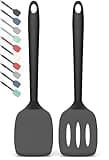
Coukre 2 Pack Silicone Spatula Set, High Heat Resistant, BPA Free Kitchen Spatula, Solid & Slotted Turner for Non-Stick Pans, Sautéing, and Flipping (2, PureBlack)
See price →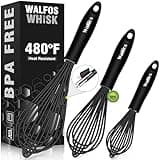
Walfos Silicone Whisk,Stainless Steel Wire Whisk Set of 3 -Heat Resistant 480°F Kitchen Whisks for Non-stick Cookware,Balloon Egg Beater Perfect for Blending,Whisking,Beating,Frothing & Stirring,Black
See price →Wooden utensils are also broadly safe across cookware types, with one caveat: rough or unsanded edges on cheaper wooden utensils can, over time, contribute to micro-scratching on softer nonstick coatings, especially with repeated scraping motions. Well-finished wood from a reputable maker avoids this, but it's worth checking reviews specifically for edge quality before assuming any wooden utensil is automatically nonstick-safe.
For a kitchen with a mix of cookware types — which describes most homes — silicone removes the guesswork entirely. If your cookware is mostly stainless steel, cast iron, or carbon steel with no nonstick coating to protect, that advantage matters much less, and the choice comes down to feel and heat behavior instead.
Heat and open-flame safety
This is where wood has a genuine, physics-based advantage. Silicone is heat-resistant, not heatproof — most food-grade silicone is rated to roughly 450–500°F, which comfortably covers stovetop cooking, but a utensil left resting directly against an open gas flame or the hot metal rim of a cast iron pan can scorch, soften, or in worst cases begin to degrade at the point of contact.
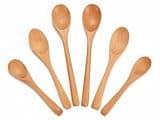
6 Piece Small Wooden Spoons Set - Premium Beech Wood Spoons in 3 Sizes (4.9", 5.9", 7.1") for Honey, Tea, Coffee, Multi-Purpose Mini Teaspoons Utensils for Ice Cream and Soup
See price →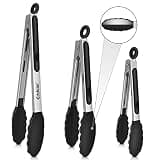
Eddeas Kitchen Tongs with Silicone Tips, Tongs for Cooking Heat Resistant 600 Degrees Stainless Steel Locking Tong - 7" 9" & 12 inch Silicone Tong Non-Stick, Black Set of 3
See price →Wood doesn't have this failure mode. It can char or blacken with prolonged direct flame contact, but it won't melt, soften, or leach anything into food the way an overheated silicone edge theoretically could. For cooks who sear regularly, use a wok over high gas heat, or rest a spoon across a cast iron skillet handle-side up while it's still on a hot burner, wood is simply more forgiving of that kind of everyday carelessness.
If your cooking style rarely involves prolonged direct flame contact — most weeknight stovetop cooking on nonstick or ceramic doesn't — this advantage matters less in practice than it sounds. But for anyone who cooks hot and fast regularly, it's a real, not theoretical, difference.
Cleaning, hygiene, and daily upkeep
Silicone's non-porous surface is a genuine hygiene advantage: it doesn't absorb liquids, oils, or odors, and it can go through a full hot dishwasher cycle indefinitely without degrading. For a busy kitchen where utensils get used daily and cleaned quickly rather than carefully, this is a meaningful, unglamorous convenience that adds up over months of use.
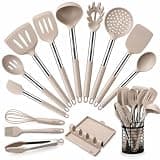
HOTEC 446°F Heat Resistant Silicone Kitchen Utensils, Cooking Utensil Set, Spatula Set, BPA Free, Kitchen Gadgets, With Stainless Steel Utensils Holder, Dishwasher Safe 14pcs Khaki
See price →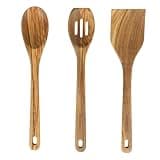
Bloomhouse Italian Olive Wood 3-Piece Kitchen Utensil Set – Extra-Large 14-Inch Turner, Spoon & Slotted Spoon, Durable Wooden Cooking Tools
See price →Wood requires more deliberate care. It should be hand washed rather than run through a dishwasher, since the combination of prolonged water exposure and high heat dries the wood out and accelerates cracking. It also benefits from periodic treatment with food-safe mineral oil to prevent the wood from drying and splitting, particularly in dry climates or homes with forced-air heating in winter.
Neither of these is a dealbreaker on its own, but they add up differently depending on how you actually use your kitchen. If low-maintenance, dishwasher-and-forget cleaning matters to you, silicone wins clearly. If you don't mind a bit of hand-washing and occasional oiling as part of caring for tools you like using, wood's upkeep is genuinely manageable rather than burdensome.
How each one ages over years of use
Well-made silicone utensils with a solid steel core and a properly sealed seam can last many years without visible wear, since the material itself doesn't degrade with normal cooking heat or dishwasher cycles. The most common failure point is that seam between the silicone head and the internal core — cheaper sets are more prone to moisture getting trapped there over time, eventually leading to cracking or separation.
Wooden Spoons for Cooking – 10 Pcs Teak Wood Utensil Set, Durable, Nonstick Safe & Heat Resistant with Ergonomic Handles
See price →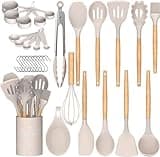
Umite Chef Kitchen Cooking Utensils Set, 33 pcs Non-Stick Silicone Cooking Kitchen Utensils Spatula Set with Holder, Wooden Handle Silicone Kitchen Gadgets Utensil Set (Khaki)
See price →Wood ages differently — it can develop a visible patina, deepen slightly in color, and pick up small marks from years of use, which many cooks consider a feature rather than a flaw. Left uncared for, though, it can dry out, crack along the grain, or splinter at stress points, particularly at the thin neck of a spoon or spatula where force concentrates during use.
Neither material is clearly more durable in an absolute sense — it comes down to how well each is made and how consistently it's cared for. A cheap silicone set and a cheap wooden set will both disappoint within a year or two; a well-made set of either, cared for properly, reasonably lasts five years or more.
Can You Use One Instead of the Other?
For the vast majority of everyday cooking — sautéing, scrambling eggs, stirring sauces, flipping on nonstick or ceramic cookware — silicone and wood are genuinely interchangeable, and most people could get by with either exclusively without noticing much difference in results.
Where substitution breaks down is specifically around sustained high or open-flame heat. Using silicone for regular wok cooking over high gas heat, or leaving it resting against a hot cast iron pan repeatedly, will shorten its lifespan and risks scorching in a way wood simply tolerates better. Conversely, using wood on delicate nonstick coatings with rough or unsanded edges can, over years, contribute to coating wear that a silicone tool wouldn't.
The practical answer most well-stocked kitchens land on is a mixed set: silicone for daily nonstick and ceramic cooking, and one or two wooden pieces kept specifically for high-heat searing, cast iron, and sauces where the traditional feel matters. A hybrid set that includes both, or buying each separately in smaller quantities, avoids compromising on either strength.
Related Tools Worth Knowing
- ›
Silicone Spatulas→ — For scraping bowls, folding batter, and precise nonstick cooking where a slotted spoon or turner is too broad a tool.
- ›
Wooden Cutting Board — Pairs naturally with wooden utensils for cooks who prefer a fully traditional, low-plastic kitchen setup.
- ›
Silicone Baking Mats — For anyone frequently baking or roasting who wants the same nonstick-safe, dishwasher-friendly logic extended to bakeware.
- ›
Metal Tongs — When you need real grip strength for flipping meat or tossing salads — a job neither silicone nor wood does as well.
Our Top Picks
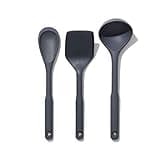
Best Wooden Utensils
Ready to buy? Check current prices below
The traditional choice — durable, natural, and open-flame safe
Frequently Asked Questions
Are silicone utensils actually safe to cook with?▾
Yes — food-grade silicone is stable, non-toxic, and doesn't leach chemicals into food at normal cooking temperatures. Stick to reputable brands that specify food-grade, BPA-free silicone, since quality can vary on very cheap imported sets.
Can wooden utensils go in the dishwasher?▾
It's not recommended. The combination of prolonged water exposure and dishwasher heat dries out wood fibers and accelerates cracking and splitting. Hand washing and drying promptly, with occasional mineral oil treatment, keeps wooden utensils in good condition for years.
Is silicone or wood better for nonstick pans?▾
Silicone is generally the safer default for nonstick cookware, since it's guaranteed soft enough not to scratch coatings. Well-finished wood with smooth, sanded edges is also safe, but rough or poorly finished wooden utensils can contribute to coating wear over time.
Do silicone utensils melt on the stove?▾
Quality food-grade silicone won't melt at normal stovetop temperatures, but it can scorch or soften if left resting directly against an open flame or a very hot pan edge for extended periods. Avoid leaving silicone tools propped against direct heat when not actively in use.
How often should I oil wooden utensils?▾
Roughly once a month with regular use, or whenever the wood starts to look dry or feel rough, is a reasonable baseline. Food-safe mineral oil works well and should be wiped on, left to absorb for a few hours, then wiped off before the next use.
Conclusion
For most kitchens built around nonstick and ceramic cookware, silicone is the better everyday choice — it's dishwasher-safe, won't scratch coatings, and holds up well over years of use with minimal care.
If you regularly cook over high or open-flame heat, or you simply prefer the traditional feel of wood for stirring sauces and risottos, a few wooden pieces are worth keeping alongside a silicone set rather than instead of one. Most experienced home cooks end up with both: silicone as the daily default, wood reserved for the specific situations where it genuinely performs better.
Check the top picks above for well-reviewed sets at each price point, or consider a hybrid set if you'd rather not choose between the two outright.
More Comparisons
Related Rankings
See the full ranking
←10 Best Kitchen Utensil Sets of 2026